Science
Fusion Startup Holds Net Energy Gain for 10 Minutes
A private fusion company sustained net energy gain for 10 straight minutes on Tuesday, the longest continuous fusion burn ever recorded. The result marks a turning point for commercial fusion, shifting the conversation from whether ignition is possible to how long it can last.
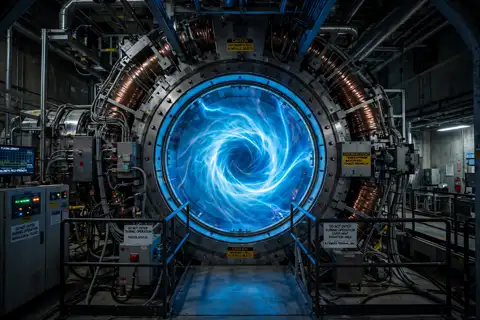
Illustration: Clear News
HELIOS FUSION LAB, Washington (October 13, 2026). A fusion startup said Tuesday it sustained net energy gain for 10 straight minutes in its prototype reactor, the longest continuous fusion burn ever recorded and a milestone researchers called the most important in the field since the first laboratory ignition in 2022.
Helios Fusion Systems of Richland, Washington, reported that its Helios-2 reactor produced 1.8 times more energy than was injected to heat its plasma during a burn that began at 9:42 a.m. and ended just after 9:52 a.m. Plasma temperatures held above 150 million degrees Celsius for the full duration, the company said, verified by instruments at two outside laboratories.
"This is the moment the conversation changes," said Dr. Amara Okafor, the company's chief executive, at a press briefing. "We are no longer asking whether fusion works. We are asking how to keep it running, and for the first time, we have an answer measured in minutes instead of seconds."
Previous records for sustained net gain were measured in fractions of a second. The 2022 ignition at Lawrence Livermore released a burst lasting less than a billionth of a second, and while laboratories in France, Japan, and China have since demonstrated longer burns, none had produced net gain for more than a few seconds.
What made it possible
Helios credits two engineering advances for the breakthrough. The first is a new superconducting magnet array that maintains magnetic confinement with far less energy input than previous designs. The second is a real-time plasma control system, driven by machine learning models, that adjusts magnetic fields thousands of times per second to suppress the instabilities that have historically ended fusion reactions early.
The company has published a summary of the diagnostic data in a peer-reviewed paper posted online Monday, though outside scientists cautioned that full independent confirmation will take months. "The numbers are extraordinary, and the paper is thorough," said Dr. Elena Vargas, a plasma physicist at Princeton University who was not involved in the work. "If the results hold up under scrutiny, this is genuinely historic."
What comes next
Helios says it will attempt a one-hour burn in its next-generation machine, Helios-3, now under construction in Richland. The company projects the plant could feed power to the grid by 2031, a timeline outside experts called aggressive but no longer implausible.
Investors responded quickly. The company announced a $940 million funding round Tuesday afternoon, led by two sovereign wealth funds and several large technology firms, bringing its total capital raised to more than $2 billion. Several major utilities said they were in early discussions with Helios about power purchase agreements.
Challenges remain: converting fusion heat into electricity at commercial scale, handling neutron damage to reactor materials, and bringing costs down to compete with solar and wind. But for a field accustomed to promises measured in milliseconds, 10 minutes of net gain is hard to ignore.