Money
India's UPI Goes Live in 12 Countries
India's Unified Payments Interface has gone live in 12 countries, letting travelers and migrant workers send money instantly with near-zero fees. The expansion marks the biggest step yet in India's push to make UPI a global payment standard.
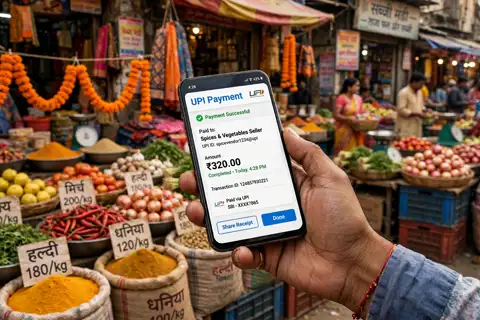
Illustration: Clear News
India's Unified Payments Interface, the real-time payment system that processes billions of transactions a month at home, has gone live in 12 countries, officials announced this week. The expansion lets travelers, students, and migrant workers send money across borders instantly with near-zero fees.
The system now works in countries across the Middle East, Southeast Asia, and Europe, including the United Arab Emirates, Singapore, France, and Sri Lanka, where large Indian diaspora communities live and work. Users can pay merchants abroad directly from their Indian bank accounts, and receive money from overseas into those accounts in seconds.
Cross-border remittances are the killer application. India receives more remittance money than any country in the world, over $100 billion a year, and traditional transfer services typically charge 5 to 6 percent per transaction. UPI's fees are a fraction of that, often under 1 percent.
"This is about the millions of workers who send money home every month," said an official with the National Payments Corporation of India. "Every percentage point in fees is money taken from a family. We think instant and nearly free is the standard the world should have."
How it works abroad
In participating countries, UPI connects to local payment networks rather than replacing them. A traveler in France can scan a QR code and pay from their Indian account, with the payment settling through the local system on the other end. Merchants receive funds in their own currency.
Several countries are building reciprocal links, allowing their own citizens to pay in India using domestic apps. Singapore's PayNow and the UAE's systems are among the first to enable two-way transfers.
A challenge to card networks
The expansion intensifies competition with global card networks and money transfer companies, which have long dominated cross-border payments. UPI processed more than 13 billion transactions in a single recent month in India, a scale that gives it real leverage in negotiations with foreign partners.
Analysts say the geopolitical dimension matters too. As countries look to reduce dependence on Western payment infrastructure, India's offer of an open, low-cost system has found a receptive audience. Several African and Latin American countries are reportedly in talks to join next.
Challenges remain. Adoption depends on local banks and merchants signing on, and currency conversion still introduces some cost. But for the estimated 35 million Indians living abroad, the change is immediate: sending money home is now as easy as sending a text.