
World
Artemis III Crew Completes Final Lunar Landing Rehearsal
NASA's Artemis III crew has finished its final full rehearsal of the lunar landing sequence ahead of the planned 2027 mission. The week-long exercise simulated every stage from orbit to touchdown, marking the last major training milestone before hardware ships to Florida.
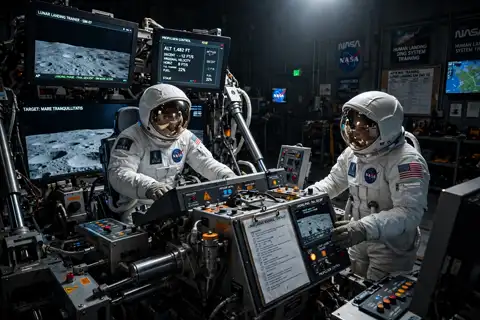
Illustration: Clear News
HOUSTON, Oct. 10(Clear News): The four astronauts assigned to NASA's Artemis III mission have completed their final full rehearsal of the lunar landing sequence, the agency announced Friday, closing the last major training milestone ahead of the planned 2027 flight that would put humans on the Moon for the first time since Apollo 17.
The week-long exercise, held at NASA's Johnson Space Center, walked the crew through every stage of the landing: separation of the Starship Human Landing System from the Orion capsule in lunar orbit, powered descent, touchdown, and the simulated surface operations that follow. Mission controllers in Houston ran the rehearsal in parallel, practicing the split-second communications timing imposed by the 2.6-second round-trip radio delay between Earth and the Moon.
"This was the run where everything had to go right, and it did," said NASA Associate Administrator for Exploration Systems in a briefing Friday. "The crew, the flight controllers, and the vehicle teams are now operating as one unit."
Rehearsal Focused on Descent and Surface Operations
Unlike earlier simulations that centered on launch and orbital rendezvous, this rehearsal concentrated on the descent phase, long considered the riskiest part of the mission. The crew practiced two full abort scenarios, including a low-fuel contingency that required a rapid ascent back to orbit for rendezvous with Orion.
The astronauts also rehearsed the first planned Moonwalk procedures, including egress from the lander airlock and operation of the new Axiom-built spacesuits, which offer greater mobility than the Apollo-era suits.
Schedule and Hardware Next Steps
With training complete, attention shifts to hardware. NASA said the SLS rocket core stage and the Orion capsule for Artemis III are in final integration at the Kennedy Space Center, with rollout to the launch pad targeted for mid-2027. The Starship lander is expected to complete uncrewed demonstration flights early next year.
If the mission flies on schedule, it will be the first crewed lunar landing in more than five decades. The crew is expected to spend roughly six days on the surface near the lunar south pole, a region never visited by humans, where scientists hope to study water ice deposits hidden in permanently shadowed craters.