
US
Ground Broken on Texas High-Speed Rail Between Dallas and Houston
Officials broke ground Tuesday on the Texas high-speed rail line connecting Dallas and Houston, the first true bullet train project in the United States. The 240-mile line promises a 90-minute trip between the two cities when service begins in the early 2030s.
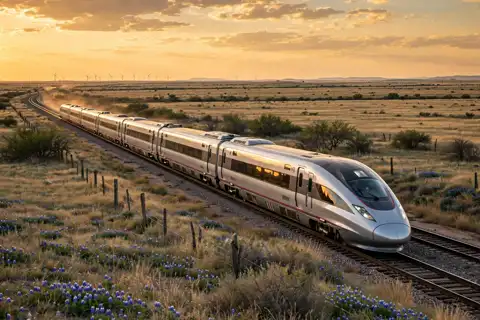
Illustration: Clear News
GRIMES COUNTY, Texas (October 13, 2026). Construction officially began Tuesday on the high-speed rail line between Dallas and Houston, the first true bullet train project in American history, with officials promising a 90-minute trip between the state's two largest cities when service begins in the early 2030s.
Hundreds of dignitaries, landowners, and rail workers gathered at a ceremony near Navasota, roughly halfway along the 240-mile route, where a gold-painted track spike was driven into a ceremonial rail segment. Actual construction will begin with grading, viaduct foundations, and utility relocation across 10 counties.
"This is the day the United States joins the rest of the developed world," said Governor Maria Delgado at the ceremony. "For decades we watched Japan, France, and China build trains that fly. Today, Texas builds its own."
The project, developed by Texas Central Partners, will use Japanese Shinkansen technology, the same system that has carried more than 10 billion passengers in Japan without a single fatal accident. Trains will run at speeds up to 205 miles per hour, cutting the current drive time of three and a half hours nearly in half and undercutting typical flight times once airport travel is counted.
The line will serve stations in Dallas, Houston, and a single intermediate stop in the Brazos Valley near College Station. Ridership projections estimate 6 million passengers per year by 2035, rising to 10 million annually by 2045.
A long road to the groundbreaking
The project has been more than a decade in the making. Texas Central first proposed the line in 2012, then spent years acquiring land parcels along the corridor, a process that drew opposition from rural landowners and several lawsuits over eminent domain authority. The Texas Supreme Court settled the question in 2024, ruling that the company qualifies as a railroad with condemnation rights.
Financing came together last year with a combination of private equity, Japanese infrastructure investment, and $4.2 billion in federal rail infrastructure grants. The total project cost is estimated at $24 billion, with completion targeted for 2032.
Critics, including some state lawmakers, questioned whether the ridership projections will hold and whether taxpayers will ultimately be asked to cover shortfalls. "We have seen rail projects promise the moon before," said State Senator Tom Becker, who voted against state participation in 2023. "Texas will be watching the numbers."
What riders can expect
When complete, departures will run every 30 minutes at peak, with one-way fares of roughly $60 to $120. Construction is expected to create 10,000 direct jobs at peak, most of them covered by agreements with Texas trade unions.
Attention now turns to California, where the state's own high-speed project between Los Angeles and San Francisco continues construction on its initial Central Valley segment, and to the proposed Cascadia line between Portland, Seattle, and Vancouver, which completed environmental review earlier this year.