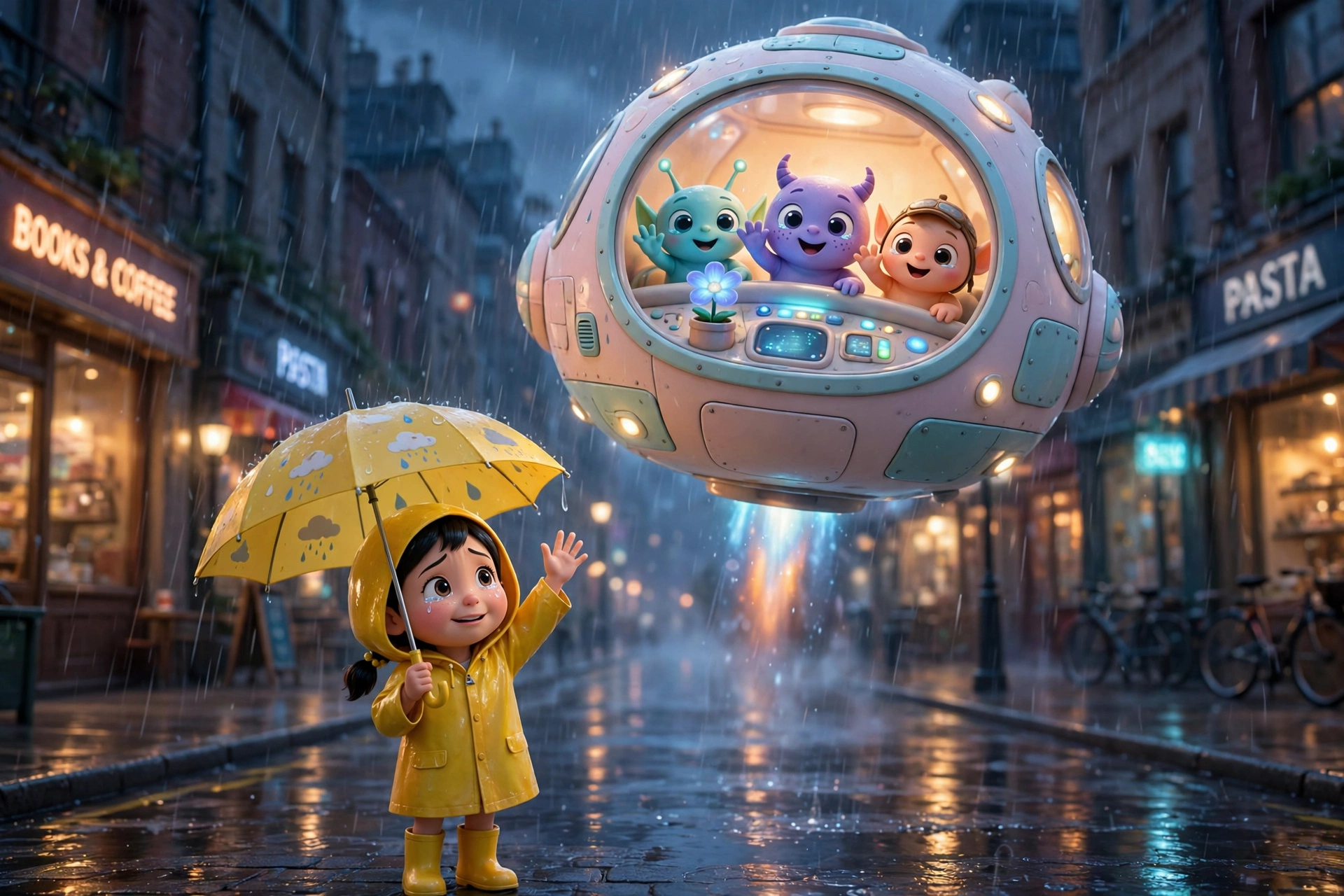
A new E2 short film, in development
Our Mission
They came to study Earth. They were not ready for Earth.
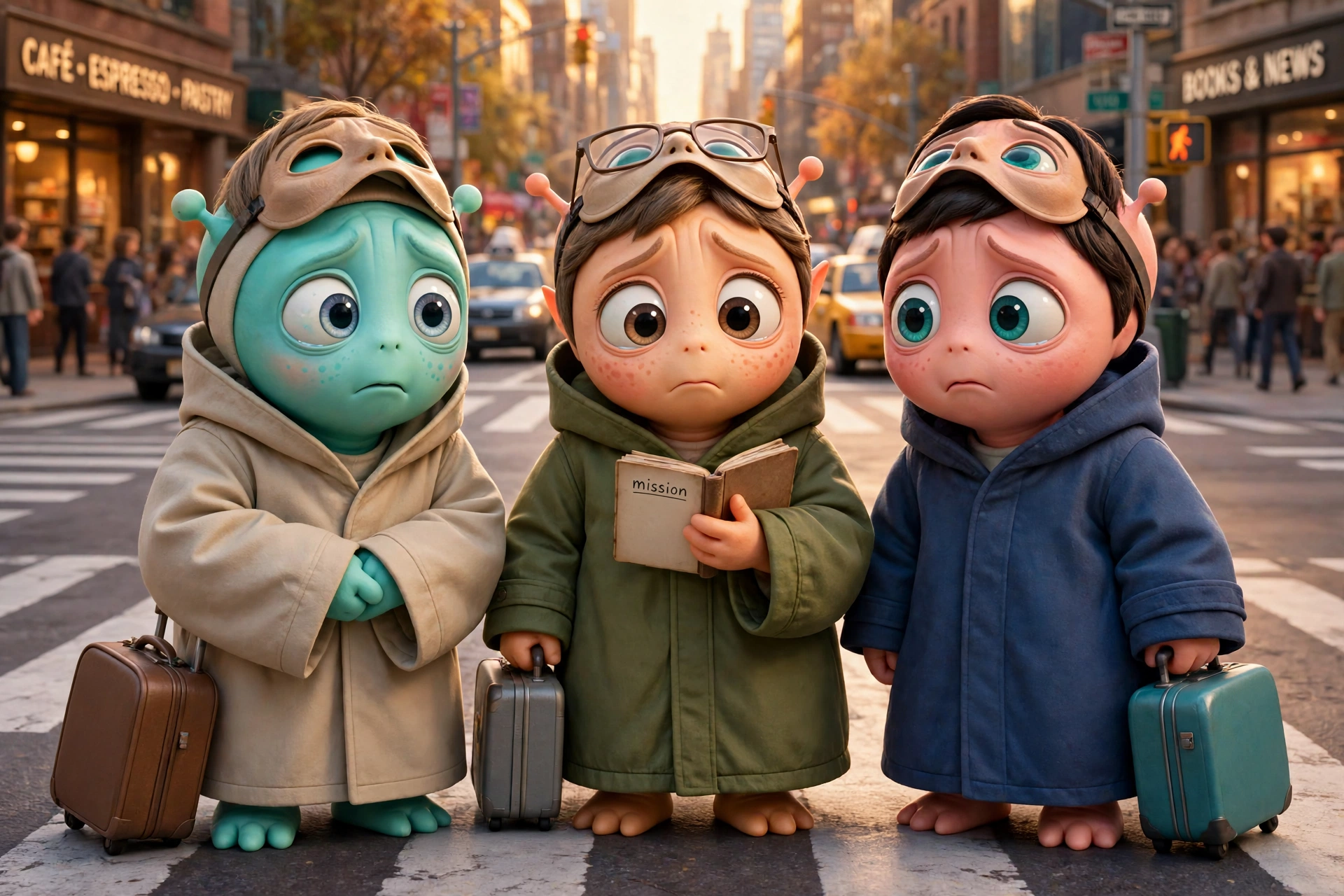
Three gentle aliens from Poz, a planet where kindness is just the weather (Poz, from paz, the old word for peace, pronounced like a held breath: pause), put on human suits and land on Earth for one simple study mission. Within a day, their hearts are broken. Within two, a stranger with an umbrella starts to put them back together.
Day one. The suits fit fine. Earth did not.
The mission brief
Expedition 03: Peaceful Contact.
That is what it says on the side of the ship. The brief itself, issued by the Poz Council of Gentle Inquiry, fits on one page, most of which is warnings written by people who have never been anywhere.
The objective, in full
"Go to Earth. Wear the suits. Learn how the humans thrive. Take notes. Come home." Five sentences of orders, zero sentences of preparation for what a raised voice does to a Poz nervous system, or what sarcasm does to a Poz brain. (Sarcasm, for the record, nearly ends the mission on day one. They keep hearing two things at once, and both of them hurt.)
🥸Rule 1: Blend in
The suits handle this. Badly. Sleeves too long, masks that slip, a tail incident in a grocery store that the report describes only as "resolved with kindness and tape."
👀Rule 2: Observe only
Do not interfere with Earth. This rule survives until day two, when interfering turns out to look a lot like holding a door, and nobody on the crew can bring themselves to stop.
🆘Rule 3: Signal if sad
If Earth gets too heavy, signal for pickup and the ship comes at once. They signal on day one. Then, on day two, standing under a shared umbrella, they radio back and cancel it themselves.
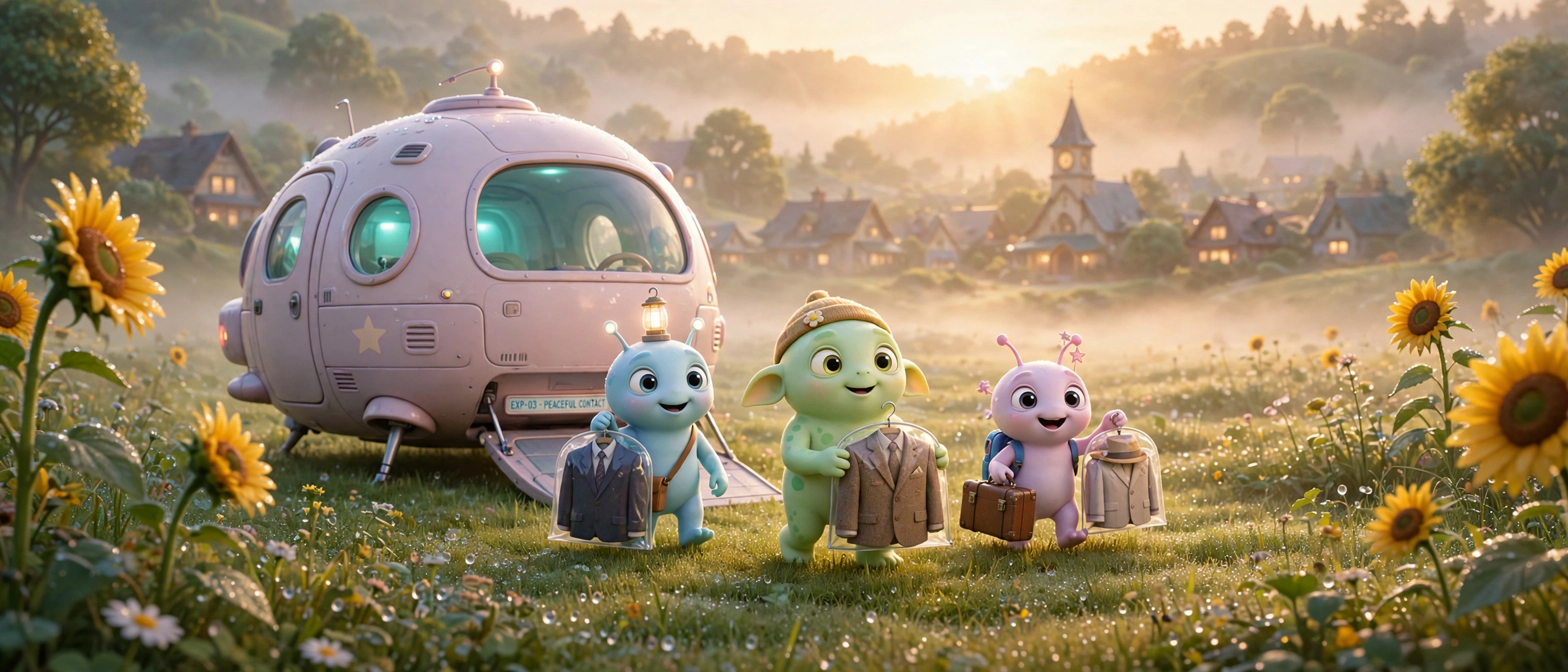
Touchdown: a meadow, at dawn.
They land where the brief said to land: somewhere quiet, somewhere kind, within walking distance of humans. A sunflower field outside a small town, dew on everything, church bells somewhere far off doing their gentle morning thing.
First impressions, recorded by Nilo in the notebook, in his best handwriting: "Earth smells wonderful. Earth is soft. Nobody here knows we are coming, and still the sunflowers turned to watch." He underlines that last part twice. He is, at this point, still optimistic.
Suiting up.
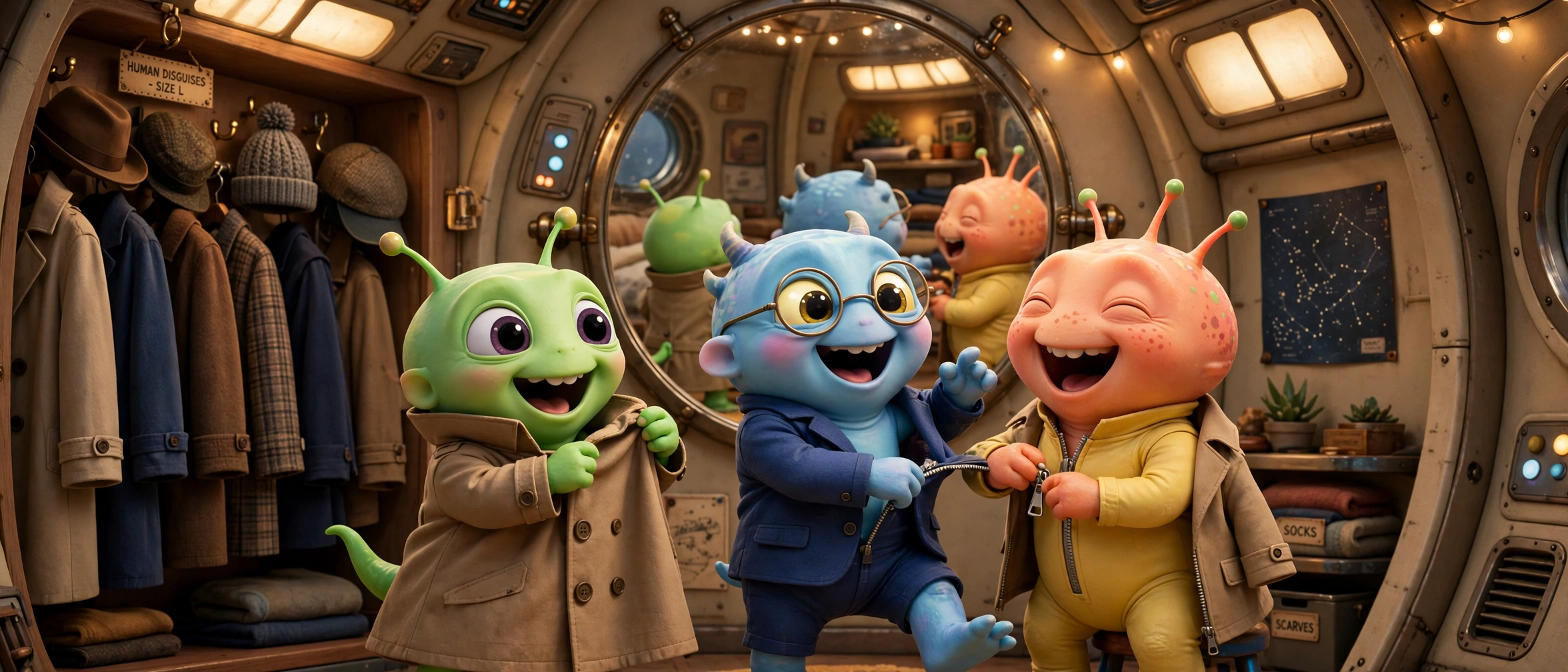
The wardrobe department of the ship is one closet, labeled, with great optimism, "Human Disguises, Size L." Everything in it is the wrong size for everyone aboard.
This is the funniest ten minutes of the film and the crew knows it: zips, wrong arms, one suit worn fully backwards to the waist before anyone notices. Under the comedy sits the real engine of the story. These three are about to trust a costume with their whole hearts, in a place that can tell.
The story
A kind planet sends its kindest. Earth sends traffic.
Home: Planet Poz.
On Poz, nobody honks. Doors are held as a reflex, leftovers travel house to house, and saying a mean thing out loud is so rare that children think it is a myth from old books. Kindness there is not a virtue. It is the weather. You do not praise it. You just live in it.
So when Poz finally sends a study mission to Earth, it sends three of its softest citizens, in human suits, with one notebook and one question: how do humans thrive?
Day one: the shock.
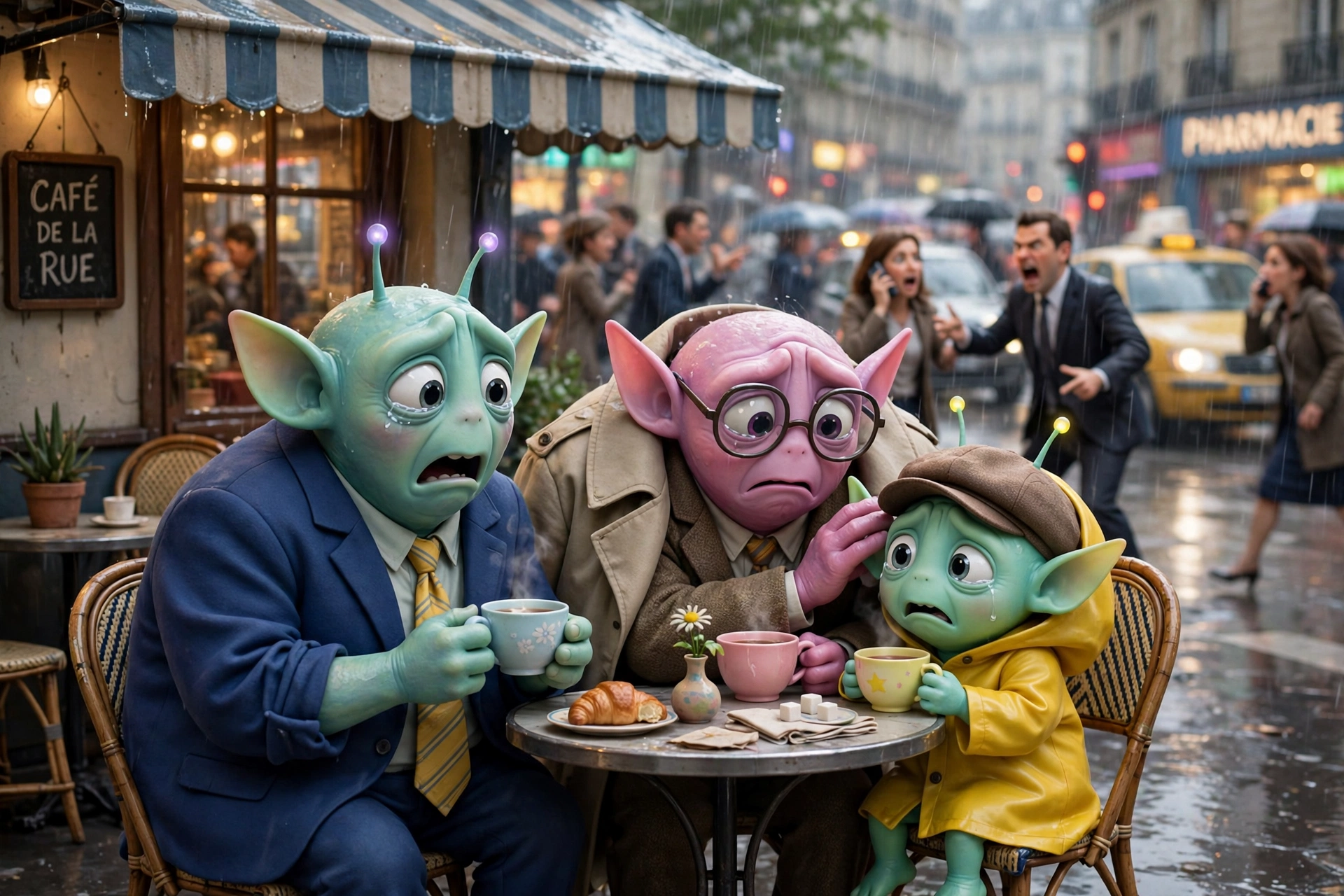
Earth answers fast. Shouting in traffic. Cruelty typed casually under strangers photos. People pushed past, talked over, laughed at. The visitors do not get angry. They get startled, the way you would if gravity suddenly stopped working.
Their first report home is three words long: "They are hurting." Mission control reads it twice and quietly starts preparing a rescue ship.
Day two: the umbrella.
Then, in the rain, a small girl in a yellow coat does the most ordinary Poz thing in the world: she shares her umbrella with three wet strangers whose suits are coming apart.
It is not the only kindness they find. It is just the first one they are close enough to feel. A door held here. A meal quietly paid for there. Earth, it turns out, has weather too. It just has to be made, by hand, on purpose, every single time.
Day three: the practice.
Rule 2 does not survive contact with gratitude. The crew starts small: holding doors, with far too much ceremony. Returning dropped things. Complimenting strangers with a sincerity so total that one man has to sit down.
Something strange happens by the afternoon. The town starts copying them. Not because they are impressive. Because kindness, witnessed up close, is contagious in a way that shouting, thankfully, is not. Ora updates the notebook in capital letters: "IT SPREADS."
23horns honked at the crew on day one alone
2 to 9doors held for them: day one vs day three
1umbrella shared, total mission impact: everything
0regrets, per the final signed report
Day five: homeward.
The ship comes at dusk, in the rain, because the film believes in symmetry. June is there, because June is always there when it rains. She does not ask them to stay. Poz kids are raised better than the rest of us, and June, honorary Poz by then, simply waves until the window is a star.
On the dashboard, in a little pot, rides the flower they gave her, and she gave back, because on Poz a gift you keep alone is only half a gift. It glows the whole way home.
Meet the human
"You looked wet."
June, age seven, umbrella owner, is asked later why she stopped for three strangers in slipping suits in the rain. That is her whole answer, and it is the whole film. June is not an angel and not a symbol. She is a kid who was raised by people who stop. The visitors spend the rest of the voyage trying to write a thank you note worthy of her, and failing, and sending it anyway.
The final report
"Earth is not unkind. Earth is unpracticed. On Poz, kindness is the weather. On Earth, kindness is a choice, and that makes it braver."
The visitors go home loving Poz more than they ever did, because now they know what it costs to live without it. And they leave one thing behind on Earth: the mission, handed to anyone willing to practice.
Log, Day 1"Why do they shout?"
Observed: humans raise their voices at strangers, then go home and are gentle with their dogs. Filed under: confusing, and sad.
Log, Day 2"The umbrella event"
One small human, one umbrella, three visitors kept dry. Morale: fully restored. Request: one more day.
Log, Final"Recommendation"
Do not rescue the visitors. Send more umbrellas. Earth is closer to Poz than Earth thinks.
Field notes
Five days, as recorded.
Day 1Arrival
Touchdown and first contact. Meadow landing goes perfectly. First human contact does not: a man shouts at a machine, then at the sky, then, briefly, at Pim. The crew files it under weather events and takes shelter in a cafe to recover.
Day 1Evening
The signal. Ora counts the days kindnesses on one hand and has fingers left over. Nilo drafts the pickup signal with a shaking hand. Pim asks the question the whole film hangs on: "If they can be this mean, why is their music so beautiful?"
Day 2The umbrella
June. Rain, a ripped suit seam, and a seven year old with an umbrella and no hesitation at all. The pickup signal is cancelled by unanimous vote, 3 to 0, in the rain, out loud, to nobody.
Day 3The practice
Rule 2 is retired. The crew begins practicing Earth kindness the Poz way: deliberately, ceremonially, and in public. The town notices. The town, to everyones shock including the towns, joins in.
Day 4The hard talk
Nilo breaks first, honestly. He tells June they are not from here, all of it, the ship, the suits. She considers this for a long moment and says the line that ends the argument Earth was having with itself: "I know. Your zipper is on your front."
Day 5Homeward
Departure and report. The ship lifts at dusk. The final report is filed from orbit, and its last line is read aloud at every Poz school assembly to this day. You can read it in the dark band above.
Evidence
Small kindnesses, catalogued.
Ora insists the report include exhibits. These six made the final cut, out of hundreds logged. None of them cost much. All of them were witnessed by at least one visitor, usually through tears.
🚌Exhibit A: The Driver Who Waited
A bus driver held his whole route, full stop, so an old man could finish crossing, then waved him on like a king arriving. Twenty strangers watched. Nobody honked. The notebook calls this "the miracle of the intersection."
🧾Exhibit B: The Vanishing Payer
At the grocery store, a woman quietly paid for the groceries of the flustered dad behind her, and was gone before he could say more than thank you to the air. Pim has thought about her every day since.
💺Exhibit C: Seat and Snack
A teenager on the train gave up his seat and then, after a moments thought, his snack too, to a tired stranger. Two gifts, escalating. Ora's margin note: "They improvise it. It is not even trained."
🐈Exhibit D: The Park Cats
Every morning, in all weather, a lady feeds the park cats and knows each one by name and grievance. The crew attended four mornings running. On the fourth, she had named one of the cats after Nilo.
🎵Exhibit E: The Singing Nurse
In a clinic waiting room, a nurse sang, low and steady, to a frightened patient who was not hers, until his hands stopped shaking. The crew stood in the doorway and understood Earth a little better.
☂️Exhibit F: The Umbrella
One child, one umbrella, three wet strangers. Entered into evidence with the notation, in all three handwritings at once: "The whole mission. This was the whole mission."
The visitors
Three suits. Three soft hearts.
Every mission needs a crew. Poz sent the wrong people for a hard planet, which is exactly why they are the right people for this film.
📓Nilo, the Captain
Earnest, by the book, and completely unprepared. Nilo writes everything in the mission notebook, including the parts that make him cry at a crosswalk.
💛Ora, the Heart Reader
Poz's kindness scientist. Ora measures a place in small mercies per hour. On Earth she finds almost none, and then, suddenly, everywhere she looks.
🧳Pim, the Smallest
Suit sleeves past his hands, suitcase nearly his size. Pim feels everything first and loudest, and he is the first one the girl in the yellow coat saves.
The family
Our third kind of story.
E2 asks: what if a corner of the internet was kind? Short Bus asks: what if a school was kind? Our Mission asks the biggest version yet: what if a whole planet was kind, and it came to visit this one?
🌍E2
The town. A kind community of creatives, helping each other level up, right here on Earth.
🚌Short Bus
The school. Kinder kids, bigger dreams, and a little bus that runs on kindness.
🛸Our Mission
The visit. A short film about seeing Earth the way a kind stranger would, and deciding to practice anyway.
The shape of it
Three acts, twelve minutes.
🌅Act 1: Suit Up
Poz at its softest, the brief, the wardrobe, the meadow landing. Pure warmth and comedy. The audience falls for the crew completely, which is the setup the film needs.
🌧️Act 2: Earth Hurts
Traffic, comments, sarcasm, the signal for pickup. The comedy keeps breathing (the suits keep failing) while the heart of it quietly breaks in the rain.
☂️Act 3: Practice
June, the door holding epidemic, the hard talk, the dusk departure, and the report that reframes everything: Earth is not unkind, it is unpracticed.
Music notes
Born as songs, kept as cues.
Our Mission began life in the Studio songbook under its old name, Human Suits. The film keeps three of those song titles as its score cues, so the music and the story still rhyme.
🎺"Human Suits"
The suiting up cue. Zips, giggles, and a waltz that is one size too big for everyone dancing it.
💥"First Contact"
The first mean human, scored with total Poz sincerity: big strings for a small cruelty, because that is how it lands on them.
🌀"Two Things at Once"
The sarcasm cue. The orchestra literally plays two melodies at once and the crews brains, and the audiences hearts, melt in the same bar.
Questions
Asked, and answered.
Is Our Mission a musical?+
No. It started as one, in the Human Suits songbook days, and grew into a short film. The songs survive as score cues. Short Bus remains the musical.
How long will the film be?+
About twelve minutes. Short enough to watch on a lunch break, long enough to ruin your afternoon in the good way.
Who is it for?+
Anyone who has ever read the comments, sighed at traffic, or felt like Earth is a bit much lately. Also kids, who will mostly want to know where to get a suit.
Is Poz real?+
Poz is real the way E2 is real: a place we are building on purpose, one kind act at a time, until the map catches up.
When can I watch it?+
It is in development now: story first, then production. E2 members will see it first, right here, before it goes anywhere else.
The mission is now yours, too.
Our Mission is in development at E2: story first, then the film. Come join the town that is making it, and help us practice the weather.
Join E2 free