Starvard University · Astronomy
Know the sky above you: the planets next door, the life of stars, black holes, galaxies, and how it all began. No telescope required.

The whole course in brief
Twelve lessons, twelve big ideas.
The twelve lessons
Lesson 1
The universe is about 13.8 billion years old and at least 93 billion light-years across, and most of it is nothing. If the Sun were a marble, the nearest star would be another marble 600 miles away, with emptiness in between. Space is not mostly stars. It is mostly space.
Scale tricks help. Light from the Sun takes 8 minutes to reach you; from the nearest star, over 4 years; from the nearest big galaxy, 2.5 million years. When the numbers get silly, astronomers switch units: light-years for distance, and powers of ten for everything else. The skill is not memorizing the numbers. It is feeling how much emptiness sits between the lights.
Lesson 2
One ordinary star, eight planets, and a lot of leftover rubble. The four inner planets are small and rocky (Mercury, Venus, Earth, Mars). The four outer are gas and ice giants (Jupiter, Saturn, Uranus, Neptune). Beyond Neptune lies the Kuiper Belt, home of Pluto and countless icy bodies, and far beyond that, the Oort Cloud, a shell of comets a light-year out.
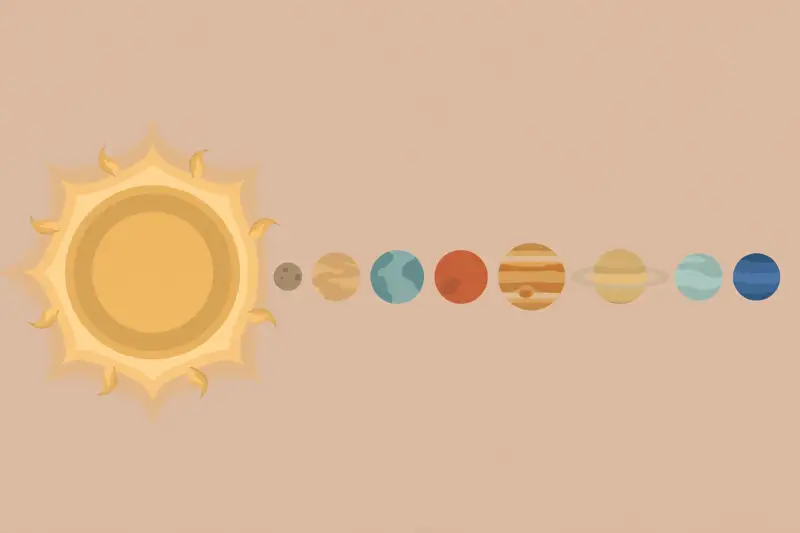
Everything orbits in roughly the same plane because the whole system collapsed from a spinning cloud. Jupiter is the bouncer, its gravity deflecting comets that might otherwise hit Earth. And Earth sits in the habitable zone, the not-too-hot, not-too-cold band where liquid water can exist. Location, location, location.
Lesson 3
The Moon is Earth's only natural satellite, about a quarter the size of Earth, and the most observed object in the sky. It was likely born in a giant collision: a Mars-sized body slammed into the early Earth, and the debris coalesced into the Moon. That is why Moon rocks look so much like Earth's crust.
The phases are just geometry. The Moon does not change; the sunlight hitting it changes angle as it orbits. A full moon is the fully lit face; a new moon is the dark face turned toward us. Tides come from the Moon's gravity tugging the oceans, with the Sun adding a smaller pull. And yes, humans walked on it: twelve astronauts, six landings, 1969 to 1972, and we are going back.
Lesson 4
The Sun holds 99.86% of the solar system's mass. It is a middle-aged, middle-sized star, about 4.6 billion years old, fusing 600 million tons of hydrogen into helium every second. That fusion is the source of essentially all energy on Earth: sunlight, weather, food, fossil fuels (ancient sunlight), all of it.
In about 5 billion years it will run out of hydrogen, swell into a red giant that likely engulfs Earth, then shed its outer layers and settle down as a white dwarf, slowly cooling forever. Do not worry about your retirement plan. Do appreciate that every warm day is a star doing nuclear fusion 93 million miles away, just for you.
Lesson 5
Stars are born when gas clouds collapse under gravity until the core gets hot enough for fusion. Small stars like red dwarfs sip their fuel and can burn for trillions of years. Big stars live fast and die young, burning through their fuel in millions of years and ending in spectacular supernova explosions.
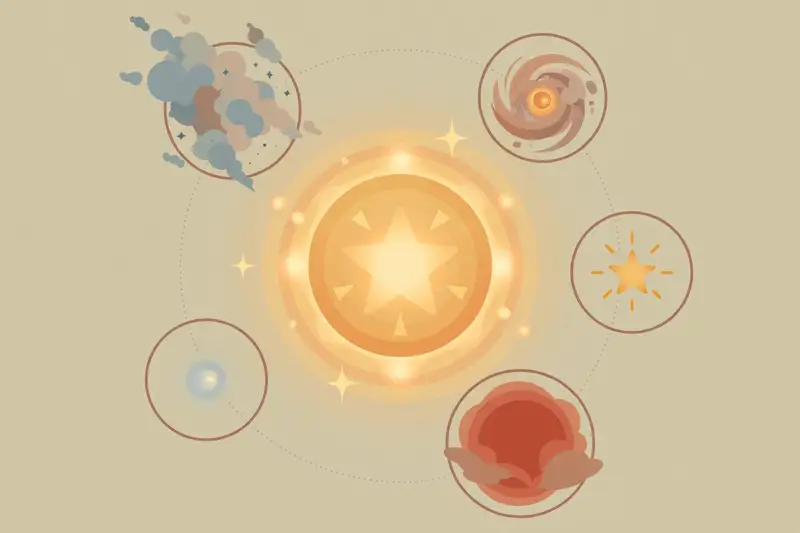
Those explosions are why you exist. Fusion builds elements up to iron; supernovae forge everything heavier and scatter it across space. The calcium in your bones, the iron in your blood, the gold in a ring: all made in dying stars. "We are stardust" is not poetry. It is chemistry.
Lesson 6
Light travels fast (186,000 miles per second) but not instantly. Sunlight is 8 minutes old when it hits you. The nearest star's light left over 4 years ago. When you look at a galaxy 10 billion light-years away, you are seeing it as it was 10 billion years ago, when the universe was young. Astronomy is the only science where the past is directly visible.
This is also how we know the universe's history. Distant galaxies look younger and messier, exactly as expected if the universe evolved over time. The cosmic microwave background, faint heat left over from the Big Bang, is visible in every direction: the afterglow of creation, cooled over 13.8 billion years to just above absolute zero.
Lesson 7
Galaxies are gravitational cities of billions of stars, plus gas, dust, and dark matter. They come in shapes: spirals like our Milky Way, ellipticals (round blobs of old stars), and irregulars (the messy ones). The Milky Way holds 100 to 400 billion stars, and it is one of an estimated two trillion galaxies in the observable universe.
Galaxies collide and merge, and ours will: in about 4 billion years the Milky Way and Andromeda will smash together into a new giant elliptical. Stars are so far apart that few will actually collide; the galaxies will mostly pass through each other and settle. Cosmic violence, politely executed.
Lesson 8
A black hole is what is left when a very massive star collapses: so much mass in so small a space that gravity overwhelms everything, even light. The "event horizon" is the point of no return. Inside it, all paths lead inward. They are not cosmic vacuum cleaners, though; from a distance, a black hole's gravity is just gravity. You could orbit one safely, the way planets orbit stars.
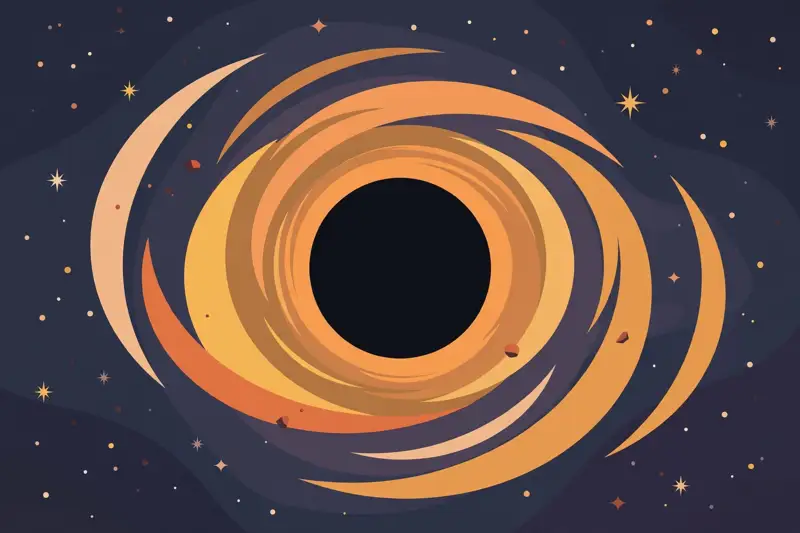
We have photographed two of them: the giant in galaxy M87 and Sagittarius A*, the one at the center of our own galaxy, four million times the Sun's mass. The images show glowing hot gas bending around a dark shadow, exactly as Einstein's math predicted a century earlier. Theory first, photo later: science at its best.
Lesson 9
Until 1992, we knew of zero planets outside our solar system. Now we know of over 5,000, and the count climbs monthly. We find them by watching stars wobble (gravity tug), dim (planet crossing in front), or by direct imaging. The variety is wild: hot Jupiters roasting near their stars, ocean worlds, diamond planets, planets with two suns.
The big hunt is for Earth-like planets in habitable zones, and for biosignatures: gases in an atmosphere that life might produce. We have found promising candidates but no confirmed life. The honest answer to "are we alone" is still "we don't know," but for the first time in history we have the tools to actually check.
Lesson 10
The universe began hot, dense, and small about 13.8 billion years ago and has been expanding and cooling ever since. That is the Big Bang: not an explosion IN space, but the expansion OF space itself. The evidence is threefold: galaxies receding in every direction, the leftover heat glow in every direction, and the observed amounts of hydrogen and helium matching the predictions.
The weird part: the expansion is accelerating, pushed by something we call dark energy, which makes up about 68% of everything and which nobody understands. Add dark matter (27%, also mysterious) and it turns out we understand about 5% of the universe's contents. The most honest sentence in cosmology is "we don't know," and it is doing a lot of work.
Lesson 11
You do not need a telescope. Start with the Moon: even cheap binoculars reveal craters and mountains. Learn a few constellations as landmarks: the Big Dipper, Orion, Cassiopeia. The planets are the bright "stars" that do not twinkle; Venus, Mars, Jupiter, and Saturn are all naked-eye visible at the right times.
Get away from city lights if you can; darkness is the cheapest upgrade. Let your eyes adapt for 20 minutes. Use a free sky-map app to identify what you are seeing. And look up often. The sky is the one screen that never needs charging and has been running the same great show for billions of years.
Lesson 12
Here is the frontier, the stuff keeping astronomers up at night. What is dark matter? What is dark energy? Did the universe have a true beginning, or does it cycle? Are we alone? Is there other life, intelligent or otherwise, anywhere in those two trillion galaxies? Each question has smart people, big telescopes, and partial clues.
The best part: these are answerable questions, or at least approachable ones. New telescopes are coming online that will map the early universe, sniff exoplanet atmospheres, and maybe, just maybe, find that we are not alone. You learned the basics in eleven lessons. The twelfth is an invitation: keep watching. The universe is still telling its story.
Graduation
Thirteen point eight billion years, two trillion galaxies, one ordinary star with eight planets, and a species of stardust that learned to look up and ask questions. That is the story so far, and you now know its main chapters. Go outside tonight, find the Moon, and remember: its light left a second ago, the starlight left years ago, and some of those photons have been traveling since before humans existed. Look up often.
Keep learning
This course is part of Starvard University, striving for greatness.