Starvard University · Habits
You do not rise to your goals. You fall to your habits. Small actions, repeated daily, quietly become your health, your wealth, and your life.

The whole course in brief
The twelve lessons
Lesson 1
Forget the motivational posters. Your life right now is the sum of your repeated actions. Your health is your eating and moving habits. Your wealth is your spending and saving habits. Your relationships are your attention habits. You do not need a new personality. You need better defaults.
Goals are fine for setting direction, but they do not do the work. Nobody ever got fit from the goal of getting fit. People get fit from the habit of walking every morning. Winners and losers share the same goals. They do not share the same systems.
The math of habits is compounding. One percent better every day sounds like nothing, and it ends the year nearly 37 times better. One percent worse compounds too. You are always compounding something. This course is about choosing what.
Lesson 2
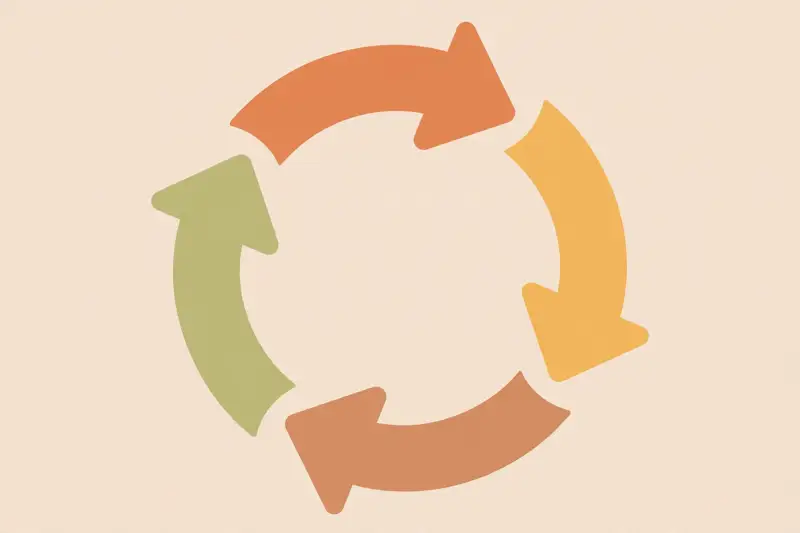
Every habit runs the same four-step loop. Cue: something triggers it, the time, the place, the feeling. Craving: you want the reward. Response: you do the thing. Reward: you get the payoff, which teaches your brain to run the loop again. Cue, craving, response, reward. That is all a habit is.
Once you see the loop, you can engineer it. Want to build a reading habit? Cue: book on the pillow. Craving: curiosity about the story. Response: read ten pages. Reward: the satisfaction of the story plus a checkmark. Want to break a habit? Attack the loop at its weakest link, usually the cue or the reward.
The loop also explains why habits are so sticky. Your brain automates repeated loops to save energy, moving them from conscious effort to autopilot. That is the superpower and the trap. Build the right loops and autopilot works for you. Ignore them and autopilot works against you.
Lesson 3
The biggest mistake in habit building is starting too big. I will work out an hour a day, meditate 30 minutes, write 2,000 words. Motivation is high on day one and gone by day four. Big starts depend on motivation. Small starts do not need it.
Make the habit so small it is embarrassing: two pushups, one page, one minute of meditation, floss one tooth. The point is not the two pushups. The point is showing up, casting a vote for your new identity, and building the neural groove of the routine. You can scale up later. You cannot scale up a habit that died on day three.
There is a rule for the hard days: never miss twice, and on the worst day, do the two-minute version. The two-minute version keeps the streak and the identity alive. Consistency at small scale beats intensity at no scale, every single time.
Lesson 4
Willpower is a depleting resource. Environment is a permanent one. The person with junk food on the counter and the person with fruit on the counter have the same willpower. They do not have the same environment, so they do not have the same diet.
Design for the behavior you want. Want to read more? Put a book on your pillow and the phone charger in another room. Want to exercise? Sleep in your workout clothes with shoes by the door. Want to eat better? Make the healthy food visible and the junk food invisible, or absent. Every good choice you automate through design is willpower you save for something else.
Design against the behavior you do not want. Delete the app instead of resisting it. Unsubscribe instead of ignoring. Tell the waiter not to bring the bread. Make bad habits hard: add steps, add distance, add friction. You are not weak for needing this. You are smart for using it.
Lesson 5
New habits struggle because they have no trigger. Habit stacking solves this by bolting the new habit onto an existing one. The formula: after I do this thing I already do, I will do the new thing. After I pour my morning coffee, I will write for ten minutes. After I brush my teeth, I will do twenty squats.
It works because the old habit is already automatic, so it carries the new one along. The cue is built in and reliable. Pick stacks that make natural sense: the new habit should fit the time, place, and energy of the old one. Morning routines stack well. Commutes stack well. Bedtime stacks well.
Start with one stack, not five. After coffee, I meditate for two minutes. Run it for two weeks until it feels automatic, then add the next link. Over months, you build chains of behavior that run themselves. Your morning becomes a machine that produces the person you want to be.
Lesson 6
Every action has a friction cost: the steps, time, and hassle between you and the behavior. Lower the friction on good habits and raise it on bad ones, and behavior changes with almost no willpower involved.
Removing friction looks like this: gym bag packed by the door, guitar on a stand instead of in a case, healthy snacks at eye level, running shoes by the bed, the document open to yesterday's last sentence. Each removed step makes starting 10 percent more likely, and starting is the whole battle.
Adding friction looks like this: phone in another room while you work, TV unplugged, credit card left at home, junk food requiring a drive. You do not need to make bad habits impossible. You need to make them take twenty seconds longer. That pause is often enough for the wiser part of you to show up.
Lesson 7
What gets measured gets repeated. A simple tracker, an X on a calendar, a checkmark in a notes app, turns an invisible habit into a visible streak. The streak becomes its own motivation. You do not want to break the chain.
Keep tracking dead simple. One mark per day per habit. If you miss the fancy app or the complicated spreadsheet, you will quit tracking, and then quit the habit. Paper calendar on the fridge works. The best tracking system is the one you will actually use for a year.
The golden rule: never miss twice. Missing once is an accident, life happens. Missing twice is the start of a new habit, the habit of not doing it. If you miss Monday, Tuesday is non-negotiable. This single rule has saved more habits than any motivational speech ever will.
Lesson 8
You cannot just delete a bad habit. The loop needs its reward, so you have to replace the routine while keeping the cue and a healthier reward. Smoke break at 3pm? Keep the 3pm break and the walk outside, replace the cigarette with a walk and a mint. Same cue, same break, different routine.
Attack the cue first. Most bad habits have obvious triggers: the couch after dinner, the phone in bed, the vending machine at 3pm. Change the trigger and the habit starves. Rearrange the room, change the route, change the schedule. Identity helps too: I am not someone who snacks after dinner is stronger than I am trying not to snack.
Expect the extinction burst: when you first resist, the craving gets louder before it fades. That is the habit dying, not a sign you need it. Ride out the wave, it peaks in minutes, and each wave you ride makes the next one smaller. Replacement plus cue control plus patience breaks any habit.
Lesson 9
Some habits are keystones: they hold up everything else. Exercise is the classic. People who start exercising regularly, without trying, start eating better, sleeping better, smoking less, and feeling more patient. One habit cascades into five.
The big three keystones are movement, sleep, and planning. Move your body daily and energy, mood, and discipline all rise. Protect your sleep and willpower, focus, and emotional control all improve. Spend ten minutes planning the day and everything else gets more intentional. Get these three right and the rest gets easier.
If your life feels chaotic, do not try to fix twelve habits. Fix one keystone. Exercise is usually the highest-leverage first domino because it improves the body and the mind at once. Small, daily, non-negotiable. The cascade will surprise you.
Lesson 10
Most people build habits from the outside in: I want to run a marathon, so I will train. Identity-based habits work inside out: I am a runner, so I run. Every action is a vote for the person you believe you are. Cast enough votes and the identity becomes self-fulfilling.
This is why the language matters. I am trying to quit smoking keeps the identity of a smoker who is struggling. I am not a smoker ends the debate. Each time you act in line with the new identity, you add evidence. You do not need to be perfect. You need a majority of votes.
Pick the identity first, then ask: what would this person do today? A healthy person takes a walk. A writer writes a paragraph. A calm person pauses before reacting. Small votes, daily. You do not need motivation when you have identity. You just do what people like you do.
Lesson 11
You will fall off. Travel, illness, stress, a bad week, something will break the streak. This is not failure. It is the normal course of a long habit. What matters is never the fall. It is the speed of the recovery.
The danger is the all-or-nothing story: I missed three days, the streak is ruined, why bother. That story turns a speed bump into a cliff. Replace it with data thinking: what broke the routine, and what would prevent it next time? A missed workout because of travel suggests a travel workout. A missed week because of stress suggests a two-minute minimum version.
Build the comeback in advance. Decide now: when I miss, I restart the next morning with the smallest version. No guilt spiral, no starting over Monday. The people with the best habits are not the ones who never fall. They are the ones who get back on fastest.

Lesson 12
Let us assemble everything into a working system. Step one: pick one keystone habit, just one, and define its smallest version. Step two: stack it onto an existing routine with an after-I-do-this trigger. Step three: design the environment, remove friction from the good, add friction to the bad. Step four: track it with a single daily mark.
Step five: tie it to identity. Write the sentence: I am the type of person who does this. Step six: set the never-miss-twice rule and a two-minute minimum for bad days. Step seven: review weekly, two minutes, note what worked and what broke. Run this for one habit for a month before adding a second.
One habit at a time, small starts, designed environments, tracked daily, tied to identity. That is the whole system, and it is how ordinary people build extraordinary lives. Pick your first habit today. Make it tiny. Start tomorrow morning.
Graduation
You know the loop, the tiny start, the stacked trigger, the designed environment, the friction lever, the tracker, the never-miss-twice rule, the keystone cascade, and the identity vote. Habits are not about intensity. They are about showing up small, daily, for a long time. Pick one habit. Start absurdly small. Let compounding do the rest.
Keep learning
This course is part of Starvard University, striving for greatness.