Starvard University · Spanish
Over 40 million people speak Spanish at home in the United States, and half a billion speak it worldwide. This course gets you conversational: pronunciation, the verbs that matter, and real practice from day one.

The whole course in brief
Twelve lessons in ten points. The rest is practice.
The twelve lessons
Lesson 1
Spanish is the most useful second language an American can learn, full stop. It is spoken by neighbors, coworkers, and customers in every US city, it unlocks travel across Latin America and Spain, and it opens career doors in healthcare, education, business, and public service.
It is also one of the most approachable languages for English speakers. The pronunciation is consistent, thousands of words are cognates (words that look and mean the same, like "hospital" and "animal"), and the grammar, while different, is logical and regular compared to English's chaos.
Set your goal clearly: conversational fluency, the ability to hold a real conversation about real things. Not perfection, not literature. Conversation. Every lesson in this course points at that target.
Lesson 2
Spanish spelling is honest. Each vowel makes exactly one sound, always: a (ah), e (eh), i (ee), o (oh), u (oo). Learn these five sounds and you can pronounce any Spanish word you read. English could never.
A few consonants need attention. The rolled R (perro) takes practice: start with the single flap R (pero, like the "tt" in "butter" said fast) and work up. The J sounds like a strong H (José = "ho-SEH"). The LL and Y usually sound like the Y in "yes." The Ñ (niño) is "ny" as in "canyon."
Stress matters. Most words stress the second-to-last syllable; written accents mark the exceptions (teléfono, café, rápido). Misplaced stress is the most common beginner error, and fixing it is just a matter of listening carefully and imitating.
Lesson 3
Start with the words you will use every day: greetings (hola, buenos días, buenas noches), politeness (por favor, gracias, perdón, disculpe), yes and no (sí, no), and the question words (qué, quién, dónde, cuándo, por qué, cómo, cuánto).
Add the survival set: numbers 1 to 20, days of the week, and the phrases "¿Dónde está...?" (where is...?), "¿Cuánto cuesta?" (how much?), "No entiendo" (I don't understand), and "¿Habla inglés?" (do you speak English?). These fifty words handle an astonishing range of real situations.
Learn words in phrases, not isolation. "Gracias" alone is fine; "muchas gracias por su ayuda" (thank you very much for your help) is a sentence you will actually use. Phrases stick because they have context. Flashcards of single words evaporate.
Lesson 4
Spanish has two verbs for "to be," and this confuses every beginner exactly once, then clicks forever. Ser is for identity and essence: who someone is, what things are, where events happen, what time it is. Soy maestro (I am a teacher). Es de México (he is from Mexico).
Estar is for condition and location: how things are right now, where people and objects are. Estoy cansado (I am tired). Está en la cocina (it is in the kitchen). The shortcut: ser = what it IS, estar = how it IS right now.
The classic pair that shows the difference: "es aburrido" (he is boring, a boring person) versus "está aburrido" (he is bored, temporarily). Same adjective, different verb, completely different meaning. This distinction is a superpower once it clicks.
Lesson 5
You can hold a basic conversation shockingly early. The template: greeting, name exchange ("Me llamo... ¿Cómo te llamas?"), origin ("Soy de... ¿De dónde eres?"), and one question about them. Four exchanges, and you have conversed in Spanish.
Memorize a few all-purpose responses: "¡Qué interesante!" (how interesting!), "¿De verdad?" (really?), "Cuéntame más" (tell me more). These keep conversations alive while your brain catches up. Native speakers love them; they signal genuine interest.
Find a conversation partner early: language exchange apps, local meetups, or a tutor for the price of a coffee. Fifteen minutes of real conversation teaches more than an hour of app exercises. Speak badly, speak often, improve fast.
Lesson 6
Spanish verbs change endings by who is doing the action. The good news: the patterns are regular and learnable. Take "hablar" (to speak): hablo, hablas, habla, hablamos, hablan. Learn one -ar verb and you know hundreds.
Start with the verbs you will actually use: ser, estar, tener (to have), hacer (to do/make), ir (to go), querer (to want), poder (can), saber/conocer (to know). These eight verbs appear in a huge share of all conversation. Master them before collecting rarer ones.
Note that Spanish often drops the subject pronoun: "hablo" already means "I speak," so "yo hablo" is only for emphasis. This is why Spanish sounds fast to beginners: fewer words per sentence. Your ear adjusts with exposure.
Lesson 7
Every Spanish noun is masculine or feminine, and adjectives match: "el libro rojo" (the red book), "la casa roja" (the red house). There is no logic to memorize; it is simply a property of each word, like spelling.
The trick that makes gender painless: always learn nouns with their article. Not "libro" but "el libro." Not "casa" but "la casa." The article carries the gender, and after a few hundred repetitions, the right article just sounds right. The wrong one sounds wrong. That feeling is fluency forming.
Most nouns ending in -o are masculine, most ending in -a are feminine, but exceptions exist (el día, la mano). Do not memorize rules and exceptions; memorize "el día" and "la mano" as complete units. Chunks beat rules.
Lesson 8
The fastest classroom is a real one. Order food in Spanish at a taquería, shop at a Latin market, ask for directions in a Spanish-speaking neighborhood. These low-stakes interactions are perfect practice: short, predictable, and forgiving.
Prepare like an athlete. Before you go, learn the ten phrases the situation needs: ordering ("quiero...", "para llevar"), paying ("¿cuánto es?", "con tarjeta"), and the polite closers ("gracias, ¡que tenga buen día!"). Walk in rehearsed, walk out conversational.
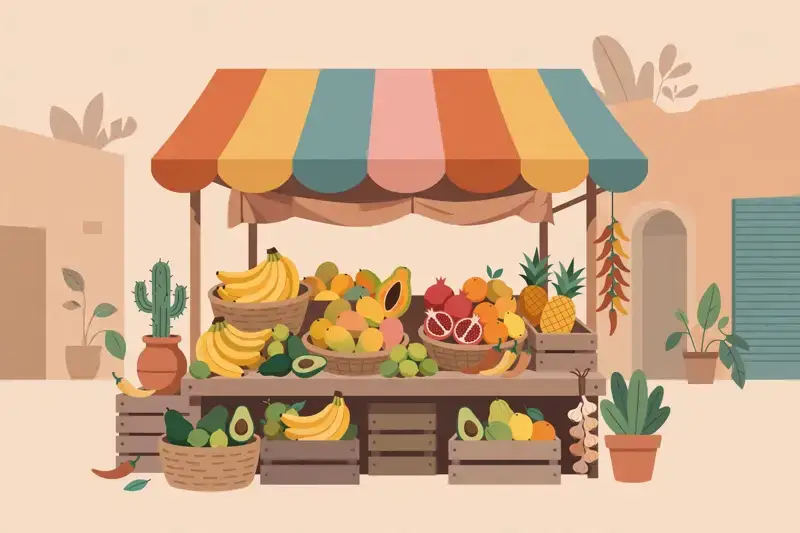
Menus are free lessons. Read the Spanish menu before the English one and guess. Food vocabulary is concrete, visual, and immediately useful, which is why it sticks. Every meal out is a study session that tastes good.
Lesson 9
Once present tense feels comfortable, add the preterite: the tense for completed past actions. "Hablé" (I spoke), "comí" (I ate). The patterns mirror the present tense you already know, with new endings. One tense, and you can tell stories.
Spanish has two past tenses, and beginners need only one at first. The preterite handles "what happened." The imperfect ("hablaba," was speaking/used to speak) handles background and habits; learn it second. Trying to learn both at once is the classic overwhelm. Sequence matters.
Start narrating your day in the past tense: what you did, where you went, what you ate. "Ayer fui al mercado y compré frutas." Daily narration turns grammar into habit faster than any worksheet.
Lesson 10
Understanding spoken Spanish is a separate skill from reading it, and it only comes from listening. Start with content made for learners: slow news in Spanish, beginner podcasts, children's shows. Understanding 70 percent of easy content beats understanding 10 percent of hard content.
Graduate to real content with scaffolding: shows you already know, watched in Spanish with Spanish subtitles. Your brain already knows the story, so it can focus on matching sounds to meaning. This is how ears get trained.
Music is a secret weapon. Find Spanish songs you love, learn the lyrics, sing along. Songs repeat vocabulary in memorable patterns, and singing fixes pronunciation in your muscle memory. Your playlist is a textbook you will actually open.
Lesson 11
Language without culture is just code. The fastest way to stay motivated is to fall in love with the cultures behind the words: the music, the food, the films, the festivals. Motivation that comes from love outlasts motivation that comes from discipline.
Pick your media diet: a Spanish-language show to follow, musicians to love, a cuisine to explore cooking. Every song lyric you understand and every joke you get in Spanish is a dopamine hit that fuels the next hundred hours of practice.
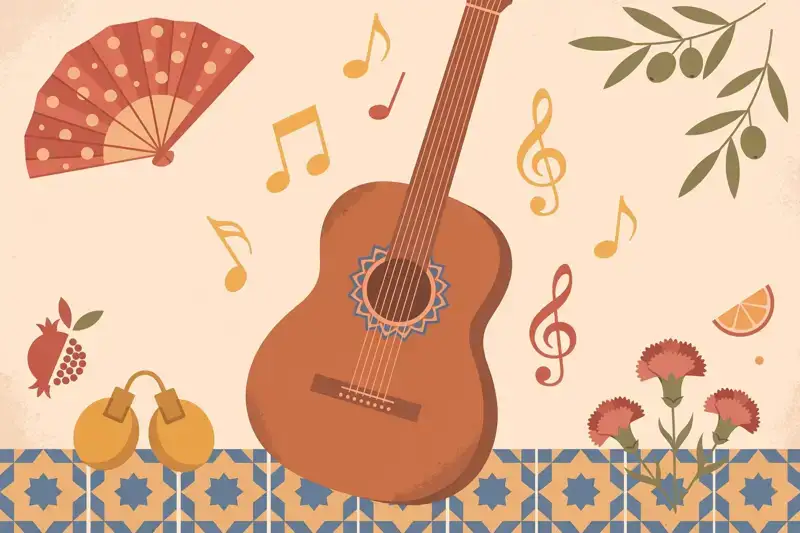
Learn the social side too: the cheek kiss greeting, the later dinner hours, the warmth of "¡mi casa es su casa." Language is behavior as much as vocabulary. Understanding the culture makes you not just understood, but welcomed.
Lesson 12
Days 1-30: sounds and survival. Master pronunciation, your first 100 words and phrases, present tense of the top eight verbs, and ser vs. estar. Speak out loud daily, even alone. Days 31-60: conversations. Weekly conversation practice, past tense basics, listening 20 minutes daily, first real-world outings.
Days 61-90: momentum. Longer conversations, a show in Spanish, a growing phrase collection, and one brave step: a full conversation with a native speaker about something real. At day 90 you will not be fluent, but you will be conversational, and you will see the path clearly.
The plan after the plan: keep going. Twenty minutes a day for a year takes most learners to solid conversational fluency. The learners who quit are not less talented; they just stopped. Do not stop.
Graduation
Speak without fear. You know the sounds, the essential verbs, the phrases that open doors, and the plan that builds fluency. Half a billion people are waiting to talk to you. Say hola and mean it.
Keep learning
This course is part of Starvard University, striving for greatness.