Starvard University · Public Speaking 101
Say it clearly in front of people. It is terrifying at first, then it becomes a superpower. Talks, presentations, toasts, interviews: same muscles, bigger rooms.

The whole course in brief
The twelve lessons
Lesson 1
Every promotion, pitch, and partnership involves a moment where you have to stand up and make your case. The person who can do that clearly gets picked over the smarter person who cannot. Speaking is the multiplier on everything else you know.
It is also the most democratic skill there is. Charisma helps, but preparation helps more, and preparation is available to everyone. Some of the best speakers in the world started out terrified. They just practiced more than the people who looked natural.
Lesson 2
Every talk has one idea. Just one. Before you write a single slide, finish this sentence: "After my talk, the audience will believe ___." If you cannot fill that blank in fifteen words, you are not ready to build the talk.
One idea does not mean one point; it means one spine that everything hangs on. All your stories, data, and examples exist to support that single belief. When in doubt, cut. A talk that says one thing clearly beats a talk that says five things fuzzily.
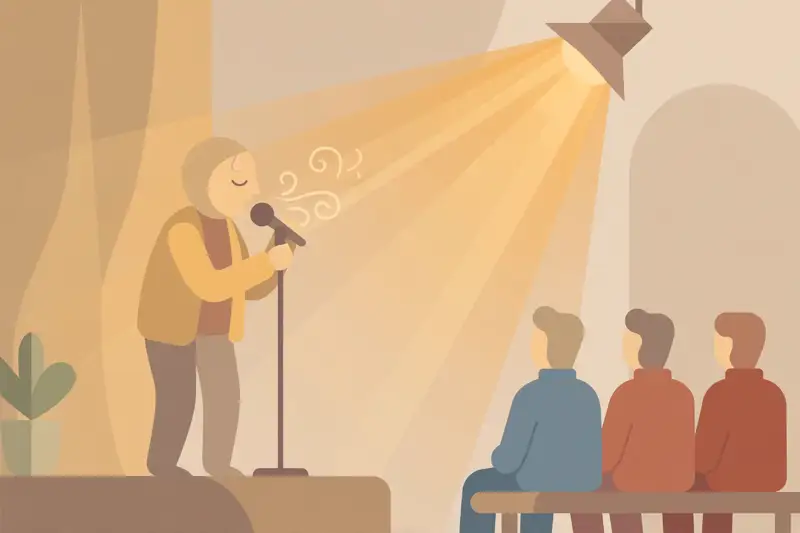
Lesson 3
Structure is what makes a talk feel effortless. The classic shape works every time: hook (grab them in the first minute), story (make it real), idea (name the lesson), proof (why it is true), payoff (what they should do). Audiences relax when they can feel where the talk is going.
Tell them where you are going: "Here is the problem, here is what I tried, here is what I learned." Signposts are not dumbing down; they are hospitality. Lost audiences stop listening, and it is always the speaker's fault.
Lesson 4
People forget data within minutes and remember stories for years. A story needs only three parts: a situation, a struggle, and a resolution. "We were losing a client, we tried something weird, it worked" is a complete story. Keep it short and specific; details make it real.
Use your own stories first. Personal beats borrowed, every time. You do not need a dramatic life; you need an honest moment. "The first time I gave a talk, my hands shook so hard I could not read my notes" earns more trust than any credential slide.
Lesson 5
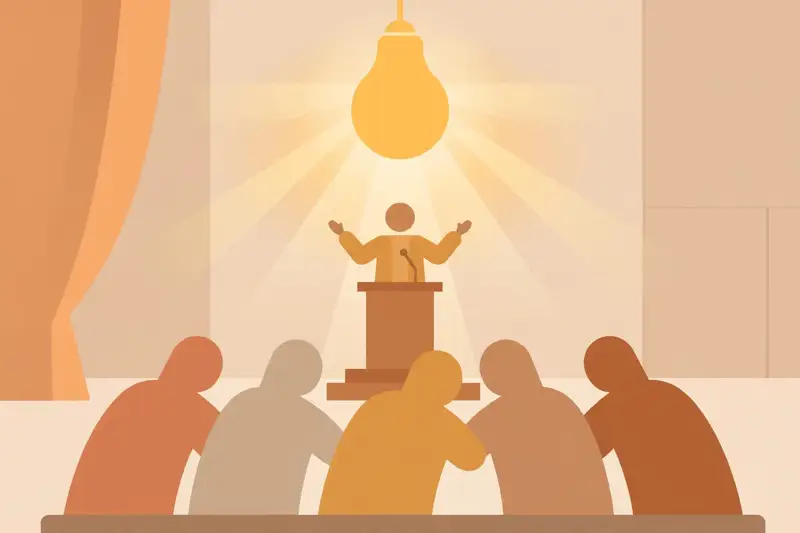
Rehearsing in your head does not count. Your mouth has to learn the words. Stand up, say the whole talk out loud, ideally to a timer. The first run will be rough; that is the point. Rough in your living room is free. Rough on stage is expensive.
Record yourself on your phone at least once. You will discover your "ums," your rushing, your mumbled endings. Three full run-throughs is the minimum for anything that matters. Pros do ten. Amateurs do zero, and it shows.
Lesson 6
The shaking hands, the dry mouth, the racing heart: that is adrenaline, and it is your body trying to help. Trying to "calm down" fights your own wiring. Instead, reframe it: tell yourself "I am excited." Studies show that one sentence measurably improves performance.
Practical tools: breathe out longer than you breathe in. Arrive early and walk the room. Have water nearby. Start with something memorized, the first sixty seconds, so nerves have no opening. The fear peaks in the first minute and drops fast. Get through the door and it gets easier.
Lesson 7
The first sixty seconds decide whether the audience leans in or checks out. Never open with "Um, thanks, so today I am going to talk about..." Open with a story, a question, a surprising fact, or a bold claim. Earn the attention before you spend it.
The ending matters even more, because it is what people carry home. End with your one idea, stated plainly, plus one action: "Here is what I want you to do." Do not trail off with "so, yeah, that is it." Land the plane on purpose.
Lesson 8
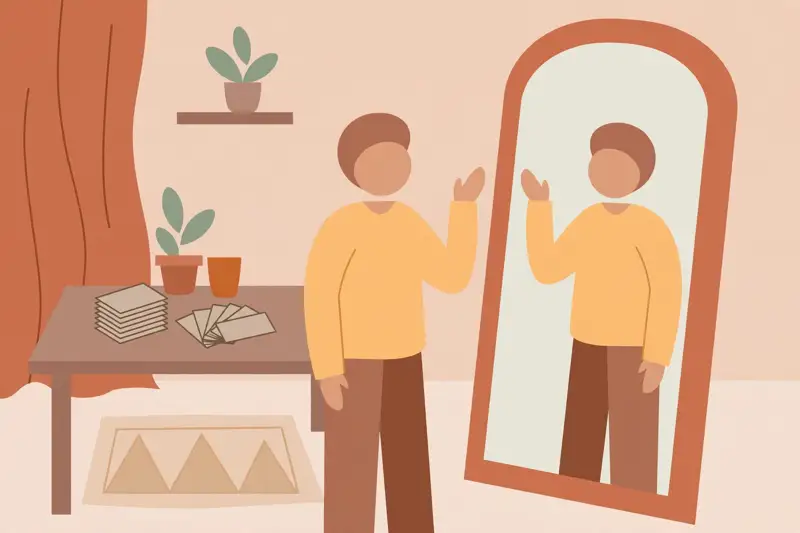
How you say it matters as much as what you say. Slow down: nervous speakers rush, and rushing tells the audience to panic. Pause after important points. Let the words land. Silence feels endless to you and perfect to them.
Stand still unless you are moving with purpose. Plant your feet, keep your hands out of your pockets, look at actual people, one at a time, for a full sentence each. The audience reads your body before your words: calm body, calm room.
Lesson 9
The slide rule: one idea per slide, almost no text. If your slide has a paragraph, the audience is reading, not listening, and reading always wins. A photo, a chart, a single number, a few words. That is it.
Never read your slides. They are the backdrop; you are the show. If the slides could replace you, delete the slides. And have a plan for tech failure: know your talk without the deck, because the projector will die the day it matters most.
Lesson 10
The scariest part of Q and A is not knowing the answer. Fix it with one phrase: "I do not know, but I will find out." It is honest, confident, and disarming. Bluffing is the only wrong move; audiences smell it instantly.
Repeat the question before answering, so everyone hears it and you buy thinking time. For hostile questions, stay warm and address the room, not the attacker. "That is a strong view. Here is how I see it." You win arguments by being the calmest person, not the loudest.
Lesson 11
Small rooms are conversations: sit down, ask questions, let it be interactive. Nobody wants a formal speech for six people around a table. Read the room and match its energy.
Big rooms need bigger everything: bigger gestures, louder voice, slower pace, simpler points. And video calls are their own animal: look at the camera, not the faces; keep it shorter than you think; use names to keep people awake. The same skills, tuned to the room.
Lesson 12
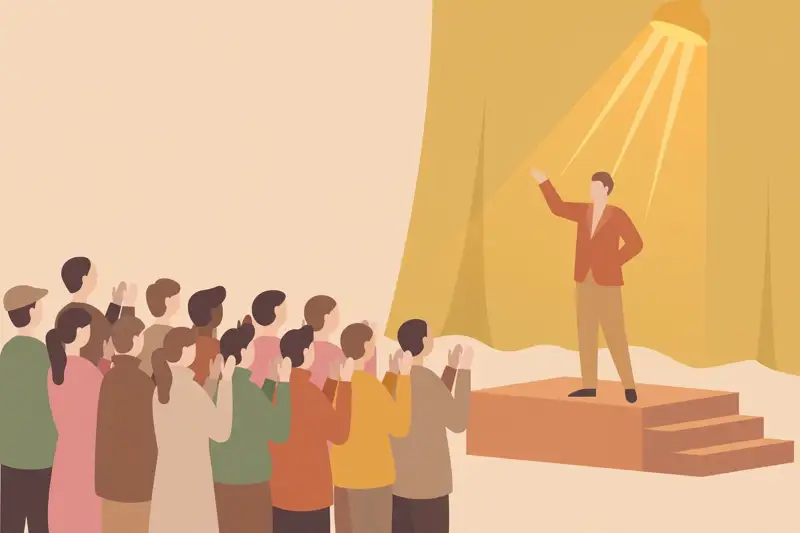
Stop waiting to feel ready. The first talk will not be great, and that is fine. Pick something small: a team update, a local meetup, a five-minute toast. The goal of talk one is not brilliance; it is surviving and learning.
Afterward, ask two people what worked and one thing to change. Write it down. Then book the next one. Speaking is a reps game, and the fastest way to get good is to get started badly and keep going. Your future self is already grateful.
Graduation
One idea. A clear shape. An honest story. Practiced out loud, nerves reframed, strong open, stronger close, slow voice, still body, simple slides, honest answers. That is public speaking: a learnable craft, not a gift. The stage is waiting, and the audience wants you to win.
Keep learning
This course is part of Starvard University, striving for greatness.