Starvard University · Yoga 101
Flexibility, balance, and breathing on purpose. Yoga is strength training in slow motion, and it starts exactly where your body is today.

The whole course in brief
The twelve lessons
Lesson 1
Strip away the incense and the Instagram pretzels, and yoga is this: moving your body through shapes while breathing slowly on purpose. That is the whole technology. The shapes build strength and flexibility, and the deliberate breathing trains your nervous system to stay calm under effort.
It is older than most civilizations and it stuck around because it works. Modern studies keep confirming the same things practitioners have said for centuries: regular yoga improves balance, reduces back pain, lowers resting heart rate and blood pressure, and measurably reduces anxiety. It is one of the highest-return activities a human can do.
You do not need to be spiritual, flexible, calm, or any particular body type. You need a floor, some clear space, and twenty minutes. The mat is optional; a carpet works. The only real prerequisite is showing up as you are.
Lesson 2
Before you learn a single pose, learn to breathe like a yogi. Sit tall, close your mouth, and breathe slowly through your nose, filling your belly first and then your chest, then emptying in reverse. Four counts in, four counts out. Do that for two minutes and notice what happens to your shoulders.
This is called diaphragmatic breathing, and it is the engine of the whole practice. Slow nasal breathing activates your parasympathetic nervous system, the rest-and-digest branch, which is why ten minutes of yoga breathing can undo an hour of stress. The poses are just interesting things to do while you breathe.
In practice, you will hear teachers cue "ujjayi breath," a slight constriction in the back of the throat that makes a soft ocean sound. Do not force it. Just breathe a little slower and a little deeper than usual through your nose, and let the sound arrive on its own over weeks.
Lesson 3
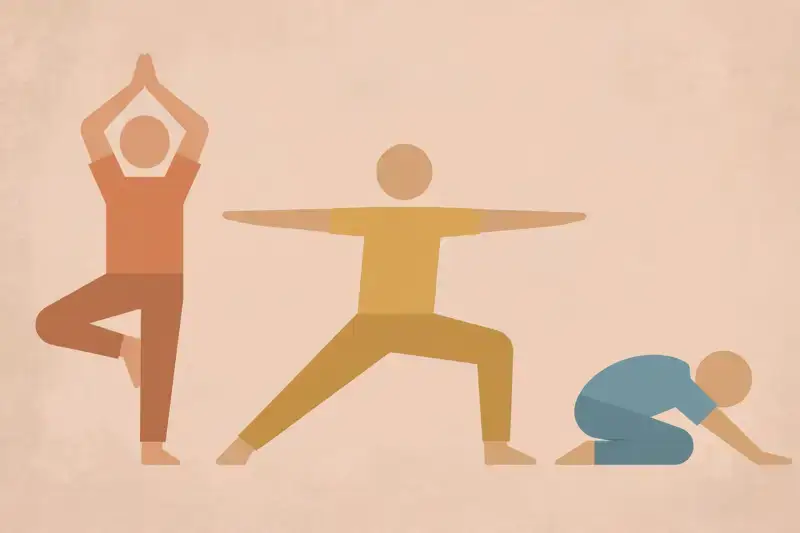
You need about five poses to start a real practice. Mountain pose: stand tall, feet grounded, shoulders relaxed. Downward dog: hips high, heels reaching down, an upside-down V. Child's pose: knees wide, forehead to the floor, the universal rest position. Warrior two: a strong lunge with arms wide. And savasana: lying flat on your back, doing nothing, which is harder than it sounds.
Learn these from a beginner video or one in-person class where a teacher can check your alignment. The details matter more than the shapes: in downward dog, bent knees are fine and a flat back matters more than straight legs. In warrior two, the front knee tracks over the ankle, not past it.
Practice the five in a simple flow: mountain, fold forward, downward dog, step into warrior two on each side, child's pose, savasana. Ten minutes. That is a complete yoga session, and you can do it every day for a month before needing anything new.
Lesson 4
"I can't do yoga, I'm not flexible" is like saying "I can't take a shower, I'm dirty." Flexibility is not the entrance requirement; it is the outcome. Tight hamstrings and stiff shoulders are exactly why you should start, and they will change faster than you expect with consistent gentle practice.
The rule of stretching is patience. Ease into a stretch until you feel a gentle pull, then breathe there for five slow breaths. Never bounce, never force past sharp pain, never compare your range to the person next to you. Muscles release when they feel safe; they grip harder when they feel attacked.
Consistency beats intensity completely. Ten minutes of gentle stretching daily will transform your flexibility in two months. One brutal hour-long stretch session weekly will mostly make you sore and discouraged. Your nervous system learns through repetition, not punishment.
Lesson 5
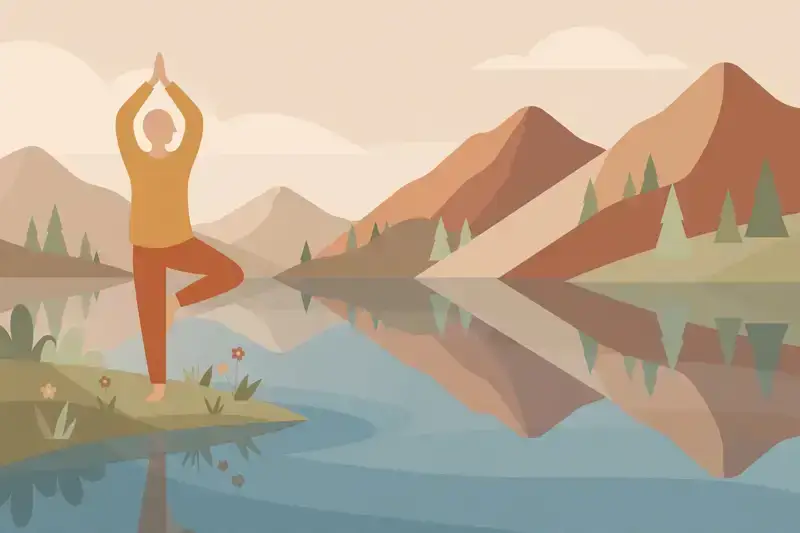
Balance is not a gift; it is a neurological skill, and it responds to practice remarkably fast. Start with tree pose: stand on one leg, place the other foot on your inner calf or thigh (never on the knee joint), hands at your heart, eyes fixed on one unmoving point. Wobbling is the workout.
The eyes are the secret. Your balance system leans heavily on vision, so pick a drishti, a single focal point, and lock onto it. When you fall out, and you will, just step back in without drama. Falling out of a pose is not failure; it is the repetition that builds the skill.
Practice balance daily, even for two minutes while the coffee brews. Stand on one leg while brushing your teeth. The payoff compounds for decades: balance training is one of the best predictors of staying mobile and independent as you age.
Lesson 6
Yoga builds core strength without a single crunch. Plank pose, boat pose, and every standing balance all demand that your deep abdominal muscles fire continuously. Hold a proper plank for thirty seconds and you will feel muscles you did not know existed.
The yogic cue is "draw the navel toward the spine," which activates the transverse abdominis, the deep corset muscle that supports your lower back. Practice engaging it in every pose. This is why long-time yogis have strong backs: the core is always on, quietly, in everything they do.
Add one minute of plank and thirty seconds of boat pose to the end of your routine, three times a week. Keep the back flat in plank, hips neither sagging nor piked. Small doses, done consistently, build a genuinely strong midsection over a few months.
Lesson 7
A home practice is where yoga becomes a habit instead of an appointment. Pick a time, ideally mornings, and a spot you can leave set up. Roll out the mat the night before if you have one. Remove every decision between you and the first breath.
Use a simple structure so you never wonder what to do: two minutes of breathing, five minutes of sun salutations or your five foundational poses, five minutes of whatever your body asks for, two minutes of savasana. Fourteen minutes total. On days you have more time, extend the middle. On days you do not, the fourteen minutes still counts.
Follow-along videos are excellent training wheels for the first few months. Pick one beginner teacher whose voice you like and stick with them for a while. But practice occasionally without a screen too, listening to your own body instead of instructions. That is where the real practice lives.
Lesson 8
The yoga menu looks intimidating, but there are only a few flavors you need to know. Hatha is slow and gentle, the classic beginner style. Vinyasa links breath to movement in flowing sequences and gets your heart rate up. Yin holds deep stretches for several minutes each, wonderful for flexibility. Restorative is basically guided napping in supported poses, perfect for recovery days.
Hot yoga adds a heated room, which makes you sweat impressively but does not meaningfully improve the workout; drink extra water if you try it. Ashtanga and power yoga are athletic and demanding; save them for later. For your first six months, hatha, gentle vinyasa, and yin cover everything you need.
Try a few styles over your first months and notice which one your body asks for. Most long-term practitioners settle into a mix: something active twice a week, something gentle once a week, and restorative whenever life is loud.
Lesson 9
Blocks, straps, and bolsters are the most misunderstood tools in yoga. Using a block under your hand in triangle pose is not a lesser version of the pose; it is the correct version for your body today. Props let you get the alignment and the stretch without forcing, which is the entire point.
The starter kit is simple: two foam blocks and one strap (a belt or towel works). Blocks bring the floor closer in standing poses and support you in seated ones. The strap extends your reach in hamstring stretches and shoulder openers. A folded blanket under the knees makes kneeling poses comfortable.
Teachers who use props constantly are usually the most experienced people in the room. They know the pose is a shape for creating a feeling, not a performance. Let the prop do its job and take the ego out of the stretch.
Lesson 10
Yoga is gentle enough that you can practice daily, but your body still needs variety and rest. Alternate active days with gentle or restorative days. If you did a strong vinyasa class yesterday, today is yin or a slow home flow. The rest days are when the strength actually builds.
Learn the difference between good soreness and warning pain. Muscles that feel worked and warm the next day are adapting. Joints that ache, sharp twinges during a pose, or pain on one side only are signals to back off and rest. Yoga injuries almost always come from pushing through warning pain.
Sleep and hydration matter as much here as in any training. Muscles lengthen and recover overnight, and dehydrated tissue is cranky tissue. A rest day with good sleep does more for your practice than a forced session on four hours of rest.
Lesson 11
The real product of yoga is not the poses; it is the nervous system you train while doing them. That slow breathing under effort becomes slow breathing in traffic. The patience you practice in a hard balance pose becomes patience in a hard conversation. The mat is the laboratory; life is the experiment.
Steal small pieces for the rest of your day. Three slow breaths before a stressful meeting. Shoulder rolls at your desk every hour. Standing in mountain pose while waiting for coffee, tall and grounded. A two-minute child's pose when the day overwhelms you. These micro-practices add up to a calmer baseline.
Notice the shift over months: you recover from frustration faster, you sleep deeper, your default posture improves. Nobody applauds these changes, but you feel them constantly. That quiet transformation is why people still do yoga after decades.
Lesson 12
Months one to three are about habit: fourteen minutes, most days, breath first. Do not add complexity; add consistency. Your body is learning the basic vocabulary of the poses, and your nervous system is learning that this is a safe, regular thing.
Months four to eight are about exploration: try a vinyasa class, try yin, hold poses longer, notice which style your body craves. This is when flexibility and balance visibly change. Take a photo of your forward fold in month one and month six if you want proof.
Months nine to twelve are about ownership: you know your practice, you can flow without a video, you adjust poses for your body without thinking. Consider a weekend workshop or a retreat if one calls to you. By the end of year one, yoga is not something you do. It is something you are.
Graduation
You know the breath, the five foundational poses, the difference between gentle and forced, and how to build a practice that fits a real life. Yoga will meet you wherever you are, every single day, for the rest of your life. Roll out the mat. The rest is just breathing.
Keep learning
This course is part of Starvard University, striving for greatness.